
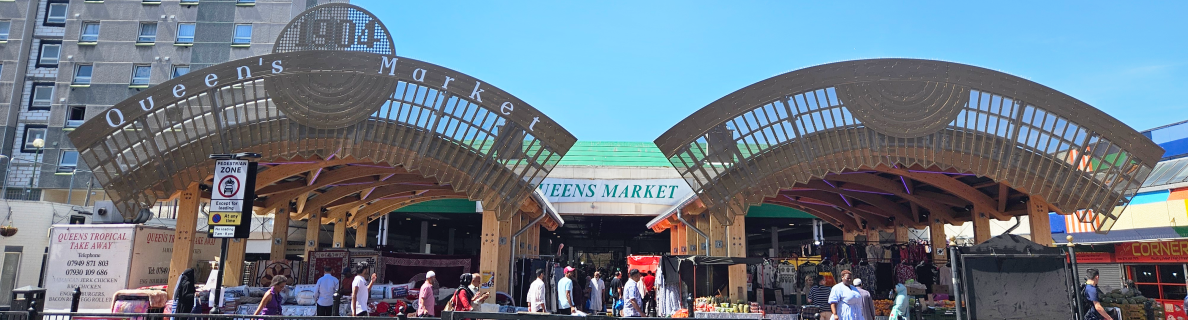
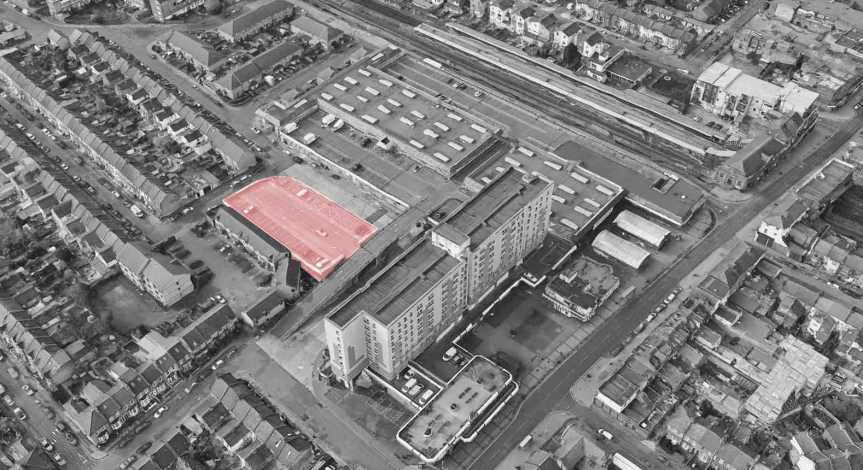
In late August 2022 Newham Council with its private consultants put in a planning application for secluded and apparently “affordable” workspaces on a corner of the car park above the market’s compound (storage area). The Council say “affordable” when it suits them – but meanwhile they have raised market rents and their rent collectors continue to threaten traders!
The workspace block is part of the Good Growth £5.3 million grant, but nobody asked for it in consultations and the council has presented no empirical evidence to show that this kind of workspace is needed here. FoQM don’t think the car park structure can handle the huge extra weight of the additional workspace – and if it cracks, the market traders’ will lose their storage compound underneath.
The building is designed to be “meanwhile use” – so it could be taken down again. This goes against all principles of Good Growth. And these plans directly threaten Queen’s Market !
You can view our objections below (scrolling pdf) and further below:
Content of our letter to the planning department:
To Jane Custance, Director of Planning and Development Emily Thorne, Planner at London Borough of Newham Sent by email to: Development.control@newham.gov.uk, duty.officer@newham.gov.uk and emily.thorne@newham.gov.uk Date sent: 25/08/2022
Objection to planning application number: 22/01752/FUL Application: Car Park, Queen’s Market, London, Newham
We would like to make an objection to the above planning application on the grounds listed below. We want Newham’s planning department to reject the proposal. We want this objection to be uploaded on the online portal alongside the application. We would like to make representation on the day of the application hearing. We object to the proposals on the following grounds:
1. Removal of car park amenity The proposal seeks to remove a car park amenity that is crucial to the shoppers that come to Queen’s Market and to Green Street to shop. This car park is needed as an overflow space from the main car park and this has not be considered in the proposal.
2. Negative effects on Queen’s Market and retail strategy The proposal does not take into account the need of the shoppers visiting the local area who need to bulk buy in their cars for their families. This is part of the shopping pattern of the area and goes agains the retail strategy for the area.
3. No local need for office spaces There is plenty of office space locally and in Newham. Stratford, a central business district is just 15 minutes bus ride away. The proposed offices are not needed in this area and can be absorbed into the high street Green Street where many offices already exist. We do not think offices next to family homes is appropriate.
4. Inadequate consultation Newham Council’s planning department and Architecture00 have failed to consult local people properly throughout this process. Initial consultations took place through Newham Co-create website despite Newham Council officers knowing that most people in Newham and the local area cannot and do not log in nor comment online. Local people say that the consultation process has been extremely complicated and their real views have been ignored. Local people only had around 20 days since the application was submitted to comment, and many local stakeholders were not notified.
5. Overlooking family homes and loss of privacy The heights of the building means that the proposed new tenants can overlook local homes and local people will lose their privacy especially on the neighbouring properties at Queens Square, 1, 8 to 14 Crown Mews, 1 to 120 Hamara Ghar, 1 to 6 & 7 to 12 Lilac Court, 2, 4, 6, 7, 8, 9 & 11 Waghorn Road and 41, 43, 45 & 47 Rochester Avenue.
6. Loss of daylight and sunlight We are very concerned about the loss of daylight coming through the windows of the neighbouring properties at Queens Square, 1, 8 to 14 Crown Mews,1 to 120 Hamara Ghar, 1 to 6 & 7 to 12 Lilac Court, 2, 4, 6, 7, 8, 9 & 11 Waghorn Road and 41, 43, 45 & 47 Rochester Avenue.
7. Poor design We do not think that the quality of materials used is longterm and shows the disregard and waste of money from the Good Growth fund that is needed to improve Queen’s Market. The design is ill-informed and does not understand how successful places work. It will create a ‘lock up’ shop environment with little permeability or flow of people and instead create a defensive wall of buildings.
8. Does not meet Green credentials nor meets environmental performance The application admits that there is a great risk of overheating and thus a fire risk. The Design & Access statement (page 33) states: “Overheating has been identified as a key risk, due to the exposed position and limited structural capability of the existing podium, as such solar gains through the fabric and glazing will have to be minimised, and high thermal mass internal linings will be necessary”. This goes against Newham’s declaration of a Climate Emergency and instead adds to global warming. The Design & Access statement (page 35) states: “Buildings that overheat cause significant discomfort and stress to the occupants and can ultimately lead to litigation and costly mitigation measures for the owners/developers”
9. Structural concerns We do not think that the existing podium structure can hold the extra weight of buildings and offices and ruins the integrity of the 1960s mock-brutalist style of Queen’s Market and it’s adjoining car park areas.
10. Building noise and disturbance If this planning application goes ahead the noise and disruption would mean that Queen’s Market will be impacted detrimentally. Street markets are fragile ecosystems and Architecture00 have failed to show any understanding of why and how Queen’s Market works. We do not think the proposed development is fit for purpose.
Yours sincerely,
On behalf of Friends of Queen’s Market
Email: friendsofqueensmarket@yahoo.co.uk
Here’s another objection letter regarding the plans for the workspaces:
Re Planning application 22/01752/FUL Workspace on top of the Compound at Queen’s Market.
I object to the principle of this planning application due to its lack of long-term benefit.
I feel the proposal does not conform with the following policies:
NPPF
Chapter 2. Achieving sustainable development
Chapter 6. Building a strong, competitive economy
London Plan
GG1 Building strong and inclusive communities
GG5 Growing a good economy
Policy E2 Providing suitable business space
Newham Local Plan
SP1 Borough-wide place-making
J3 Skills and Access to Employment
It does not conform for these reasons:
1) The proposal is designed as “meanwhile use”. This means any benefits gained will disappear after a (an unknown) period of time. Yet there is no mention of how, or if at all, these spaces would be re-located if the building was dismantled, or how that employment would be retained. A business takes time to grow and establish itself, yet the application is written as if viable businesses will be conjured up by magic for a limited period of time.
2) Building a building of any kind simply to dismantle it is not what is intended by the circular economy.
3) The Planning Statement claims that there is a ‘holistic’ vision (para 1.2) between the four Good Growth projects, but this is far from the case. What’s missing is the link with the economy and employment offered by Queen’s Market and a recognition of potential physical and strategic business connections with the Market. Instead the building comes across as a separate entity operating independently of the Market. For example, genuine links could be made with traders so that things made in the workspaces are sold in the Market. It’s not clear that the proposed spaces could serve as small manufacturing spaces.
Currently, the Market’s traders are suffering from pressure of very high rent demands which are putting business, employment and livelihoods at risk. There is no justification for this when compared with the benefits of affordable space and the provision of employment offered by this planning application. The Council will be giving with one hand, while taking away with the other.
It is claimed that the GLA asks for the following outputs from the wider scheme:
– New jobs being created, and existing jobs being safeguarded: 20
– Number of businesses receiving support: 30
– Number of people progressing into work: 30
The question is whether these figures include
– the jobs lost from rent rises and potential loss of businesses in the Market
– the lack of provision of new stall pitches, when we know there is a waiting list.
4) Consultation has been very limited and in practice not nearly as comprehensive as the application suggests. From the start, workspace was pre-decided as a Good Growth project. Following that, very limited involvement of traders and shoppers appears to have taken place, to the extent that there is little knowledge of this planning application. The actual impact of engagement is shown in the Design and Access Statement: Bi-monthly engagement workshops with a Stakeholder Working Group made up of local SME’s, residents, market trader representatives and institutional representatives. This working group has provided local insights and guidance on how / who to engage. This suggests that engagement is a lot about asking people to build up the nunbers of people consulted.
Traders who use the Compound rely on it for their businesses, but it is unclear whether these traders are aware and fully involved in this plan, which they need to be for the project to be successful.
5) With the proposed engineering of the building above the Compound it is by no means clear that it poses no threat to the structure of the Compound. Should there be a problem and structural harm is done to the Compound, there needs to be a mitigation strategy for the re-provision of this ground floor space, which is integral to the successful operation of Queen’s Market. Otherwise, this temporary, Meanwhile project poses a direct threat to Queen’s Market.
 To promote and preserve a thriving publicly-owned historic street market