
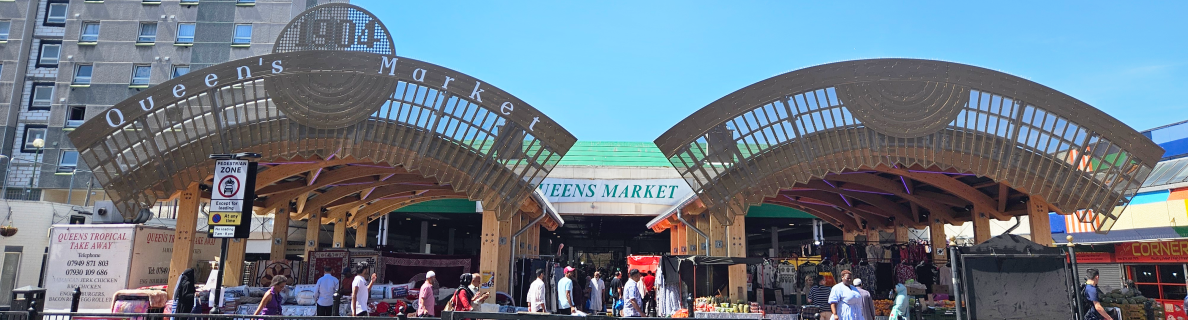

Recently Friends of Queen’s Market gathered to not only celebrate 21 years of the campaign – time flies when you’re dealing with the failings of a “rotten” borough – but also for our Secretary Pauline’s birthday – happy birthday Pauline!
At the same time FoQM collectively signed our group letter to Newham Council regarding the cumbersome and arduous public consultation process during the Council’s investment strategy consultation. The process is full of contradictions and half truths, all to justify a future plans of what looks like demolition of our much-loved market smothered with luxury, unaffordable flats. Living in the capital has become increasingly hard for long-standing communities during a cost-of-living crisis brought on by the axis-of-corruption ie. banks, ‘dodgy’ local governments and ‘greedy’ private developers. At FoQM we believe everyone makes London what it is, and everyone deserves a slice of the cake.
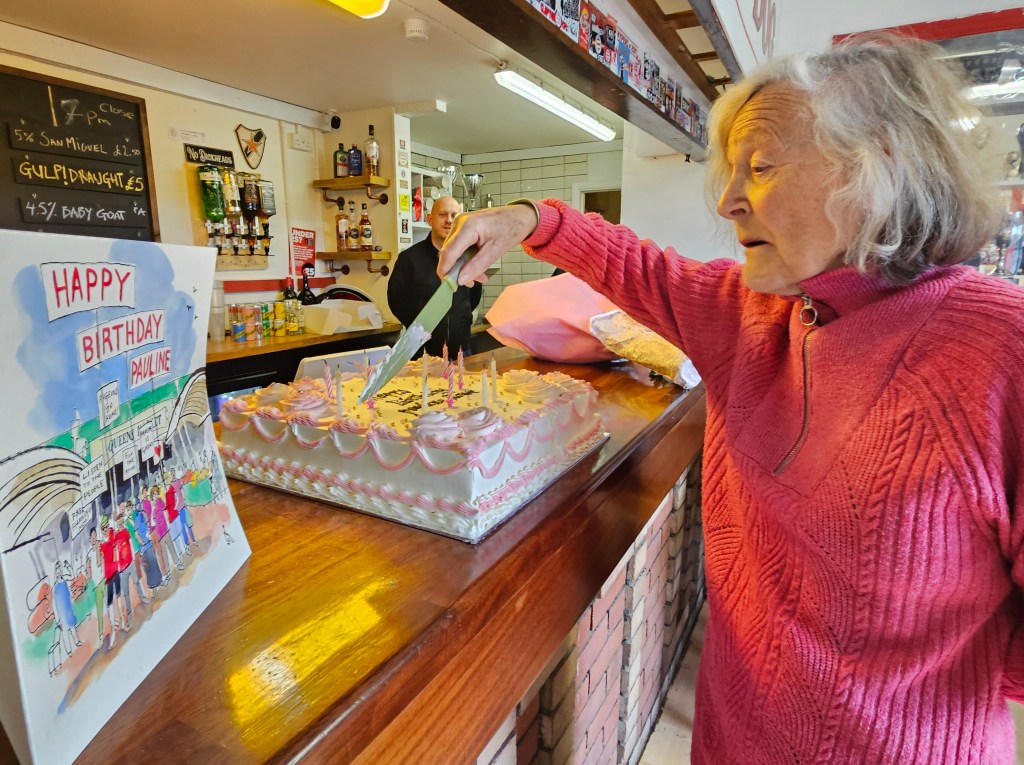
Photo (above): Our wonderful secretary Pauline divvies up the cake for all as we celebrated her birthday at a local football grounds with many of the Friends of Queen’s Market supporters in attendance. Thank you Lucy for the hand-made card.
Newham Council say that they want to retain the market but they fail to mention the “demolition” plans! The devil is in the detail when greedy developers gather behind closed doors
Read the letter
Thanks to our passionate and eagle-eyed campaigners for all of their dedication in drilling in to the detail and taking notes. Below is a PDF of the letter sent to Newham Council regarding our collective experience of the consultation process concerning Queen’s Market so far:
If for some reason you cannot read the PDF, you can read the full text below:
Date: 2 June 2024
To: clive.Kershaw@Newham.gov.uk green.street@newham.gov.uk
Dear Newham Council,
From Friends of Queen’s Market
c/o 143 Clements Road London E6 2DL
friendsofqueensmarket@yahoo.co.uk
This is the Friends of Queen’s Market response to the current consultation on Queen’s Market Investment Strategy.
1. Background
Friends of Queen’s Market is the community group formed to preserve and protect the market. We have been working for 21 years in pursuit of this aim, written into our Community Charter. We have followed and/or taken part in all stages of the ‘Investment Strategy’ study formerly called the ‘Capacity and Viability Study’.
FOQM exists to protect the service the market provides to the people who rely on affordable food and goods. Many thousands visit the market every week, around 8,000 people are thought to visit the market most days. The cost of living has always been an issue and never more than now and is not going to get better. The Council is well aware of the market’s vital role in serving Newham’s diverse communities.
To most people, ‘The Market’ means the current space, the current stalls, shops and kiosks together with the rent levels that allow traders to charge affordable prices to their customers.
On 30 August 2022 FOQM were pleased to be able to give a presentation to the Council and its consultants, as we wanted to make sure certain issues were heard and understood by those carrying out the Investment Strategy. We submitted the presentation afterwards as our response to the August 2022 consultation. It was sent to Clive Kershaw,
Darren Mackin, Tom Randle, Mike Evans, Paul Frater, Nicola Elcock, Eleanor Soames and acknowledged by Clive on 2 September. We asked for it to be included in the investment strategy’s final report.
2. “Options 2a and 2b”
We strongly object to the reduced choices being presented. Demolition and multi-use are now the only option and we dispute the Council’s justification for it.
Options 2a and 2b are taken from the last consultation, which offered two choices with and without housing on the site. At that time, Option 1 was ‘Refurbish and Modernise: retain, refurbish and modernise Queen’s Market and Hamara Ghar; maintain; adjust the layout of the market, create flexible uses and provide opportunities for the evening economy.’ Option 2 was ‘Modernise and develop’. The shop buildings, compound, below Hamara Ghar and above the market ‘to be explored for development and opportunity for new housing’. (quotes are from presentation boards 2022)
Now in both ‘options’ the market would be entirely demolished and housing would surround and dominate the site. According to what is presented and using other information and logic, the market as we know it would be under threat. A development of this size, which would most likely be under private ownership, would inevitably lead to higher rents, push out traders and force up the price of the food and other goods. Working class communities and all those who require the low-priced food because they have no other choice would suffer discrimination. Access to affordable fresh food has a direct impact on heath including health of children and other health outcomes. The market’s established social value also has a significant positive effect on health.
A street Market surrounded by housing notoriously prioritises private housing residents over market customers and traders, leading to the demise of a market or making it more expensive. We know that private apartment owners do not want to share their space with a traditional street market and we know that incoming developers want to get rid of this kind of activity.
In the case of Rathbone Market, an improved market was promised by the developers and supported by local people when they were asked about the multi-million pound scheme. Once it was built, private owners of the market let the market slide and now there is nothing left and no management. On a normal day there are about 3 stalls, or none, no fruit and vegetables: the development has drastically reduced the community value of the site.
Can the Council name a precedent for its chosen option where this has not happened?
3. “What you’ve told us” ….?
“You said new homes would be welcomed. To match the communities [sic] vision and ambitions for the site the two options now include the delivery of housing alongside other uses that are important.”
It depends which communities are being referred to. We learned that only 220 people commented at the previous stage, meaning the housing option was chosen by under 200 people. There is no way of knowing whether the need for demolition was properly explained to them, or how the question of housing was put, we need to see that data in more detail. According to “views and comments” received, the Council apparently received no comments from anyone about how important the market is to them and how it fits into their “priority of uses”. Maybe this is because the questionnaire only focused only on new uses and there was no box to tick for the market.
People who look at the market from the outside who are not shoppers or live in other parts of the borough may have said in the consultation that they want a redeveloped site, but3 their views must be partly influenced by the council’s severe neglect of the market, for example the poor state of the canopies seen from Green Street. Those people may not know the market’s importance to communities that use it, yet their views have steered the direction of the plans.
Shoppers themselves want the market to be clean and improved (as evidenced everywhere including in Newham Markets Strategy report). But they put up with it because they may have no other choice of where to shop.
In March 2002, Friends of Queen’s Market created a petition which gave people an opportunity to register their support for the market, their opposition to possible demolition and the loss of any shops and stalls and the building of expensive private housing. It asks Newham to respect and protect Queen’s Market and clearly states:
- – No demolition of trader storage area
- – No demolition of our neighbours’ home: the Hamara Ghar block next door
- – No demolition of market shops and kiosks
- – No shrinking of market trading area
- – No expensive flats for sale on the market site
This was a direct response to proposals in the Investment Strategy which had a brief published in 2020 that said: “maximise the development potential” “Identify the property market demand for the area and provide the likely values for sales and rental of both affordable and private housing products; rental and lease of the commercial floor space, health provision and community floor space”.
The petition was part of our presentation in 2022 and we informed the Council that it had about 2000 signatures at that time. 6,358 people signed the petition up to September 2023 and it was given in at the Full Council Meeting. Leaving aside the points which have since been addressed, such as toilets and the retention of Hamara Ghar, the petition remains a response to the current proposals and it should now be recorded alongside all the views that have been gathered.
If the views of over six thousand people are ignored Newham cannot be genuinely interested in consultation and so-called ‘co-production’. The Council says: We want the community to help us decide the future of Queen’s Market, the Hamara Ghar buildings and the surrounding area. But it’s obvious that the council only likes the feedback that is helpful to its own agenda. So the public is cynical: they do not believe there is a democratic, collaborative approach to the future of Queen’s Market, they see decisions being made behind closed doors that will have a very wide detrimental impact.
4. Missing information that is needed to assess the plans properly
a) The project is called an ‘Investment Strategy’
We can see no figures or financial options to compare even though the Council employed financial consultants Arcadis. The financing of a development as large as this is key to whether the existing Market would survive or disappear. Where is any information on a range of scenarios and different priorities, or a mechanism to ensure low prices to customers, such as the rent levels for stalls and shops? Where is a strategy that will “ensure the people of Newham always have access to healthy, affordable, fresh food for generations to come.”?
(Investment Strategy Study presentation 11072022)
How is ‘Community Wealth Building’ being applied to the Strategy? b) Ownership of the site
The type of ownership, public or private, is a fundamental concern and people need to know more to judge the proposals. From everything that is known about private
ownership in the UK, private owners / leaseholders would have no reason to retain the current low-priced market and that there are few, if any, levers to make them do so. In Newham we have seen what happened at Rathbone Market and Stratford Market Village, in both cases the owners were content to see these markets close or fail.
We have also been asking for years why One Source can over-charge shop tenants and avoid providing reliable leases. Who would own the shops in a new development and how would the Council keep rents genuinely affordable?
c) Converting the market from a Public Highway into a private space.
Would this need to happen if the market site was closed off and the air space built on ? If so what would the effects be? What would be lost and gained by Queen’s Market no longer being part of the public highway?
d) Housing tenure
Newham quotes 33,000 people on the housing register as a reason to build housing on the site, but without a guarantee of the number of social rented homes in the two options nobody knows whether housing would benefit the local community. A series of economic scenarios should be shown to us. Newham has a poor record for securing high numbers of social rented homes and there is no reason to believe that this case would be different. The average amount of new social rented housing in London is 6% of the total and based on the evidence we cannot support either of the Housing options: they do not provide a strong reason to jeopardise the market.
We do not believe that Newham’s housing crisis can be solved by building as many private homes as possible.
e) Timescale
A health centre / library / community use is proposed on the Compound site, no longer a site for workspace funded by Good Growth. Millions of pounds of Good Growth money will still be put into the market and Queen’s Square. What do these things tell us about the proposed timescale for the Investment Strategy? “Five to ten years” has been mentioned, does the Council not realise how it harms trade to hang these possibilities in the air for an indefinite time?
5. Lack of understanding of how Queen’s Market and street markets work
We don’t see enough attention paid to an understanding of the existing market in these plans. The consultants have shown no examples of having worked sensitively on a multi- ethnic historic street market, or anything similar. Newham has a very low number of markets per resident compared to other boroughs but despite this, Newham does not appear to appreciate what it has in Queen’s Market, the largest and most successful.
The model and diagrams appear to show that the market floor area has reduced in size yet it’s claimed there will be no reduction in the number of stalls: impossible unless the size of pitches shrinks. No existing and proposed floorspace area is given for the shops and market so we do not know whether the number of pitches would be workable. How has the figure of 166 pitches been calculated?
Lines drawn out on the floor of the model represent stalls, in reality these would be too close together and don’t allow space for the through-routes that are drawn on both schemes.
Judging from the diagrams the size of the shops has been reduced, for example there is housing at ground level on Queen Street in place of the long narrow shop spaces. Was any consultation done with the current shop owners to discover what kind of space they need? Would larger shop units be the right size for high street chains and is that the objective? Given the relationship between the shops and stalls, the impact of having chain stores cohabiting with the market stalls would be significant change and would have many implications. Has any thought been put into this?
In the current market, all stalls are under cover. The existing canopies are semi-outdoor but are only a small percentage of the market space: traders still have a choice of environment. Locating the entire market to Green Street in Option 2b is out of the question – right next to the road, traffic pollution, semi-outdoor and lacking any protection from the weather, covering the entrance to Hamara Ghar.
In the model of Option 2a, some of the stalls are not under cover and the market is pushed back from Green Street, meaning market stalls wouldn’t be so easily seen from the road. This was termed a ‘weakness’ in the previous plans.
Option 2a has “Two distinct markets with new entrances.” What are these two markets and how are they related? It is potentially damaging to divide up a market and can’t be done without sufficient understanding of how the market functions.
Kiosks have been relocated to Green Street and this fails to acknowledge the usefulness of the kiosks to traders within the market. We understand that some people wish to see a more open internal space, but why separate the kiosks from the stalls, as they provide a role as shops, storage and secure space? There should be a way to include kiosks inside.
Setting up, or altering, a market is a skilled job – the arrangement of space, allocation of stalls and space, relationships between different traders and products, hierarchy of stalls. Above all it must be based around understanding and a dialogue with traders. Has best practice been observed in designing these layouts? Have any experts been consulted?
6. Nowhere to go while demolition and construction takes place
Where would the market go if these major works take place? There was no clear answer to this question at the consultation, in fact it looked like it had not even been considered. The Council’s line “Keeping Queen’s Market open and at the heart of the community” is meaningless. If wholesale demolition is required, with the long timescales involved, we doubt that traders, and therefore the market as we know it, would be able to survive in unknown temporary positions: we are therefore strongly against demolition.
In any case, for an operation such as moving the market temporarily there needs to be 100% trust and respect between management, the Council and the traders. Unfortunately, the current management has a poor record for involving traders and stallholders; decisions are made without their input and the traders do not feel that they are counted as equals. This has been highlighted during the Good Growth works and we do not believe that a temporary market, or any such a major upheaval, would be possible to achieve under the present conditions.
Demolition will create dust and potentially harmful emissions.
7. Newham’s Market Strategy and Policy Review report and the Leeds University Markets 4 People report.
Will these pieces of work be part of the Strategy final report? They are relevant, particularly the recommendations in the Markets 4 People report. https://eprints.whiterose.ac.uk/174813/1/210531%20M4P%20Queens%20FINAL.pdf
8. Friends of Queen’s Market Presentation
FOQM made a presentation to the Council and consultants on 30 August 2022, as we thought that there were issues that needed to be covered and explained. A PDF of the presentation was sent in afterwards and received by Clive Kershaw, it formed our response to the consultation. There is no evidence to show that the information has been noted or has affected the current plans in any way.
9. Concerns about the recent consultation and in general
Consultation on this issue began during Covid lockdown and was very confusing at the same time as the Good Growth workshops and several other consultations. Also, Digital consultation methods exclude vast numbers of market users.
Current users of the market should be central to the Study yet shoppers were not considered to be stakeholders as part of the working groups.
In-person viewing of the plans was available between 16 – 30 May for less than 24 hours in total.
At the viewing, people were told: “If you don’t like it, fine, tell us why”.
- – Putting “No” as a third option was not an apparent choice, there were just the two boards.
- – If someone put a coloured sticker in the “no” box for Option 2b, is this counted as a “yes” for Option 2a? How could a “no to both” be counted?
- – The stickers are random and appeared to be combined from several sessions and could not be linked to a person or their comments.
- – Participants were not identified as being residents, shoppers, traders etc
We were also told “nothing in these plans is an actuality”, making the public input confusing. Given that about £260,000 was spent on the Investment Strategy being carried out, we need to know more.
Sunday traders should have had a chance to see the plans.
The Online Survey
This three page survey presents a totally misleading description of the plans, saying:
“Queen’s Market and Hamara Ghar are without doubt hugely important to the communities of Newham and that is why we are committed to ensuring that we preserve, restore and modernise them both”
“the two options both look to refurbish, modernise and develop Queen’s Market and Hamara Ghar”
The words preserve and refurbish present a false picture, anyone could be misled. Why is the word Refurbish being used again for Queen’s Market? The previous Option 1 was named Refurbish with Option 2 called Modernise and Develop.
Our collective experience of consultation has been less than satisfactory and we believe Queen’s Market and our future deserve a better, more effective, fairer, more wide-ranging, genuine engagement.
10. Conclusion
The proposals show a new market in a new space which looks like it is designed to bring in a new demographic. Shoppers and traders feel they are not wanted here and can be pushed out, which is causing stress and worry and is harming trade. Saying “there will always be a market” is an empty phrase that does not give any comfort.
At the consultation we heard from Clive that “It’s about providing multi-use development site that offers things the community said are important to them”. If so, the importance of the existing Queen’s Market, its economic and social impact, should be integral to the Study. And with this the economic and social impact of its loss is needed.
Creative ways could be found to provide sympathetic additional uses within the existing market buildings with minimal disruption if there was the goodwill to do so and genuine co-production, but we are not optimistic about the goodwill. Millions of ££ of public money is being provided to improve the market through the Good Growth fund yet we see few effects on the ground. Two years ago Newham’s Market Strategy report told you ‘shoppers want better cleaning’, which is the very least that people should expect and should be normal: why is it not provided?
That said, has the Study calculated the waste of millions of pounds of public money from demolition of the completed works funded by the Good Growth grant?
We believe it is completely unacceptable that the Study ignores the clear views of so many shoppers and traders yet claims that the community has chosen to demolish the stalls and shops at Queen’s Market with little likelihood that they could return.
We ask for our petition and our presentation from August 2022 to be included as part of the Study and the report to Cabinet.
Yours sincerely,
For Friends of Queen’s Market
Communities across the country have had their public assets stripped and sold off at a whim to already wealthy developers, and sadly have been ignored through the consultation process, that promises mountains and delivers molehills.
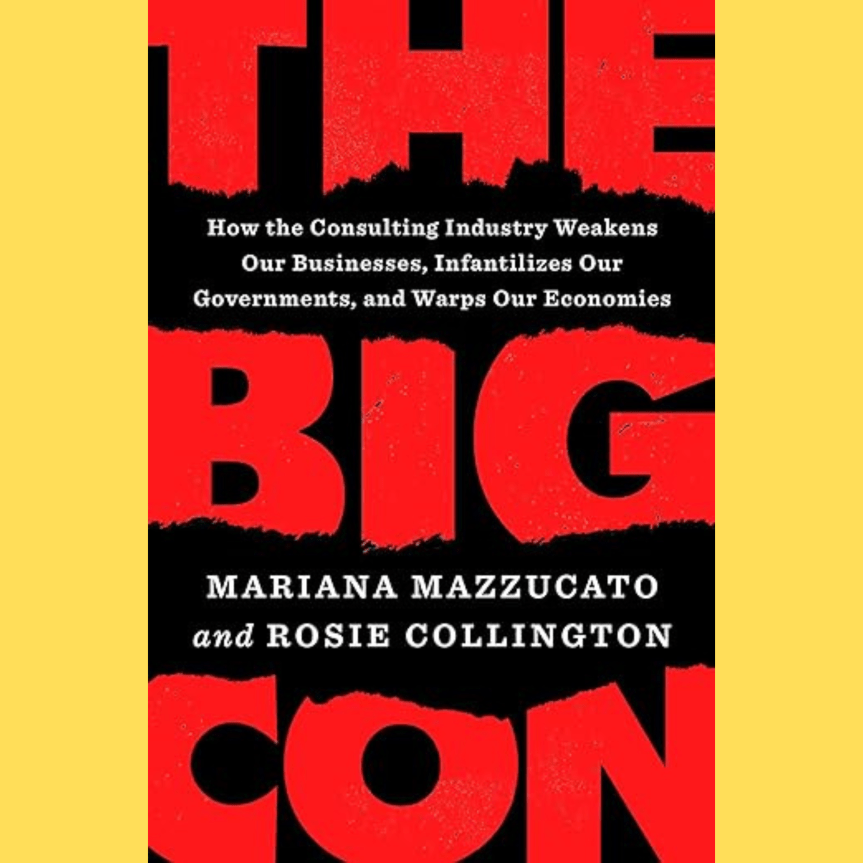
Image (above): looks like an interesting read – ‘The Big Con’, How the Consulting Industry Weakens Our Businessses, Infantalizes Our Governments, and Warps Our Economies… we know exactly what they mean!
 To promote and preserve a thriving publicly-owned historic street market