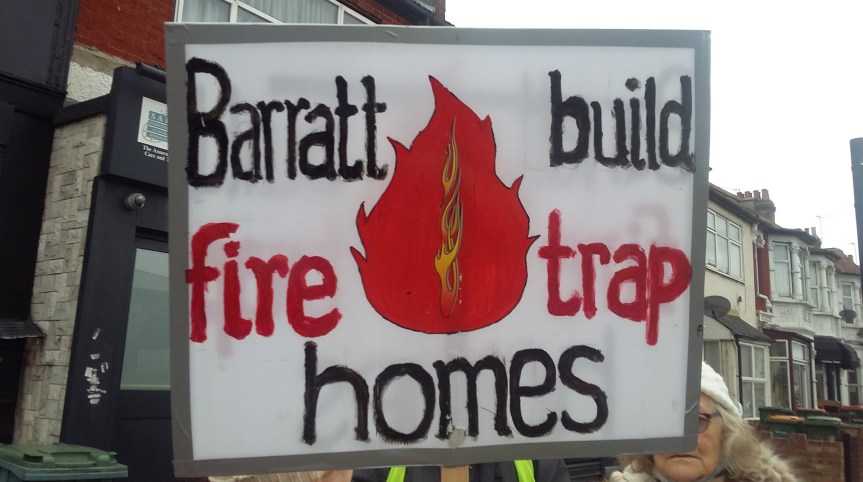
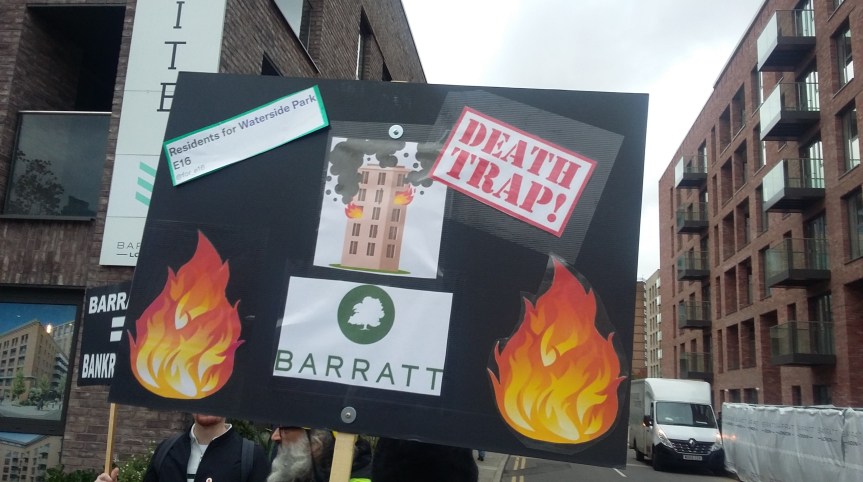
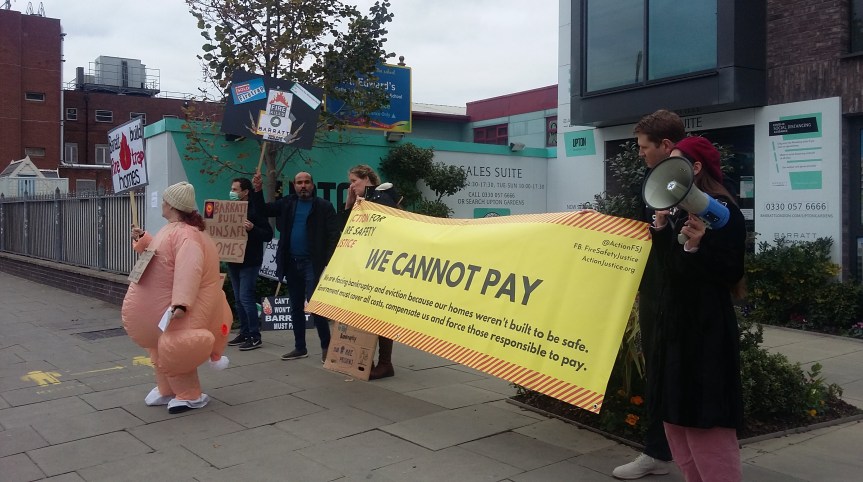
Boleyn Ground’s new Upton Gardens is a fire trap!

We know that Newham’s “preferred” private developers are keen to get their mitts on the market land but in their haste to make bucks and hand over every local asset to the ‘filthy rich’ developers they have have put lives in danger – what a shame.

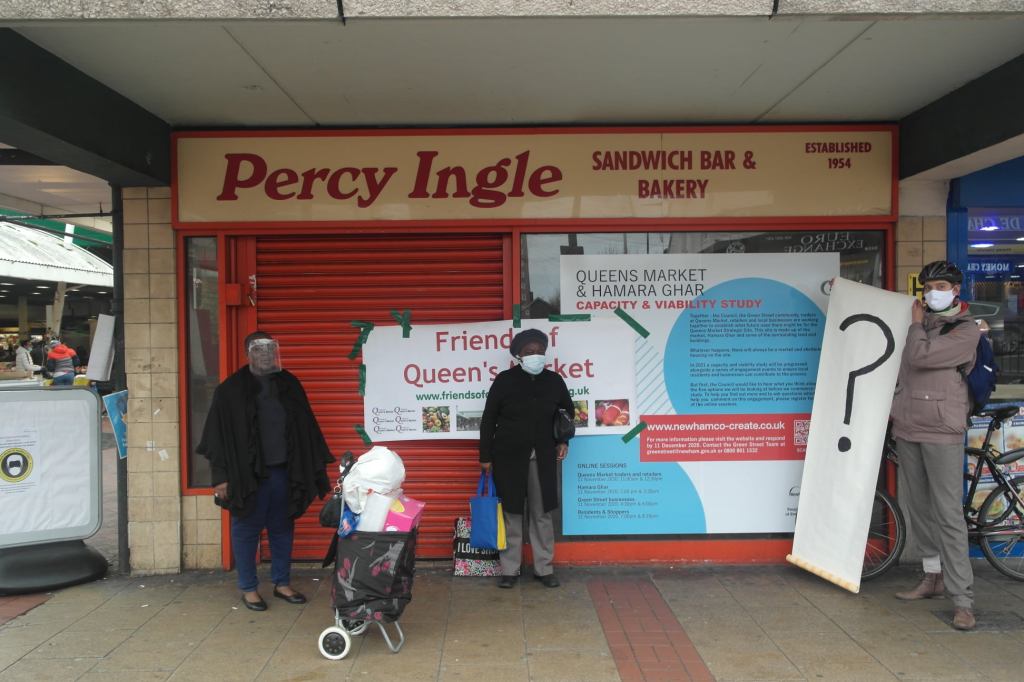
FoQM bumped into local campaigners who have moved into homes on the new Boleyn Grounds development called Upton Gardens built by Barratt Homes who claim to build “Homes of the Highest Quality”, but sadly the residents are experiencing cladding issues under the fake brick slip façade that they say put their lives in danger and out of pocket.

Since the Grenfell disaster that saw the corporate murder of at least 72 people due to the installation of cheap cladding, we wanted to encourage people to watch ‘Value Engineering: scenes from the Grenfell enquiry’, a play in the style of verbatim that shows how systematic neglect can cost human lives. The scenes from the play look only too familiar considering how responsibility has been outsourced by local Councils across the country. Below is more information about the play:

Value Engineering: scenes from the Grenfell enquiry (theatre play). Edited by Richard Norton-Taylor. Directed by Nicholas Kent.

Good Growth expenditure under question

In 2019 Newham applied for a £2 million ‘Good Growth’ grant from the Mayor of London, which they would match fund with £1.3 million. By the summer of 2020 a decision was made that a total of £5.3 million would be spent on the Good Growth Programme: £2.15 million from Newham and now with £3.2 million from the Mayor of London.

A small public consultation took place in January 2020. People who took part were asked to chose their priorities for the funds in each category but were heavily steered by the Council’s regeneration officers who had already decided that only only one quarter of this money would be spent on fixing the structure of the market, which is in need of attention. The remaining three quarters of the money is to be spent on “affordable workspace” for artists on top of the car park; the public space around Queen’s Square; and a “wellbeing centre”.  We’ve been saying for years that affordable spaces are needed inside the market’s shops, where rents have been rising. And they call this process “co-design”!

The spending on the market itself will be restricted to the floor, the lighting and the much-needed toilets. Why is the roof left out of this enormous budget? Does it really cost £1 million to plant trees and put benches in Hamara Ghar square? Is the “Queen’s Market Good Growth Programme” really about improving Queen’s market for the long term?

In the small print of this consultation the Council says,

“Alongside this investment, the Council will be assessing the long-term opportunities for the site which will include a new covered market with improved traders facilities, additional housing, health centre, affordable workspace and retail

In fact, three of the options for development would demolish the market and/or the Hamara Ghar sheltered housing, meaning that the £millions from the ‘Good Growth’ grant would be wasted.

Is the London Mayor and Greater London Authority’s “Good Growth” fund just a precursor for filthy rich private developers to ransack embedded communities?

Newham’s Co-create website = digital exclusion

Local peoples’ encounters with Newham’s Co-create website has been less than warm, with the vast majority of Queen’s Market users preferring to keep well away from it.

What we’ve found so far from the Newham Co-create website:

  • There is no safeguarding against people making rude comments about important community assets.
  • The Council and their chosen consultants are not transparent on how the data they collect will feed into the entire consultation process.
  • There are people who have worked for, are employees of, friends of or associated with Newham Council, so clearly the process is not an accurate reflection of real users of the market.
  • There’s lots of confusion between the different working groups eg. Good Growth, Capacity and Viability, Green Street and Hamara Ghar. We feel this is a “cluster of attacks” on our community.
  • There are no standard procedures, for example when one person left a working group they were not allowed onto another easily. Meanwhile we’ve heard of at least 2 Council’s “yes” people have been allowed onto multiple working groups.
  • The process of who is chosen and who is left out is not clear – many market users feel aggrieved that they cannot have a say in the future of their local area because of rules like distance from the market, number of shoppers allowed or BAME women… market users from outside of the borough are not considered adequately either.
  • The vast majority of local people are being digitally excluded simply for not being able to access online services. This process excludes many disabled, elderly and hard of hearing or less literate.
  • Our communities have lots of other priorities like bringing up and feeding families, yet the community is seen as a ‘free’ resource while private consultants get paid from the public pocket. We think this is unethical.
  • Time lines and events lists are unclear and keep changing on the Newham Co-create website.
  • Too complicated – many local people have said that the language used is jargon and hard to understand, thus misleading.

Tell us your experience: one of the FoQM volunteers is interested in tracking the Council’s consultation process and how Newham’s diverse communities encounter it. Email friendsofqueensmarket@yahoo.co.uk to let them know about your experience of Newham Co-create so far.

LINK to Newham Co-create: https://newhamco-create.co.uk/

Newham Co-create
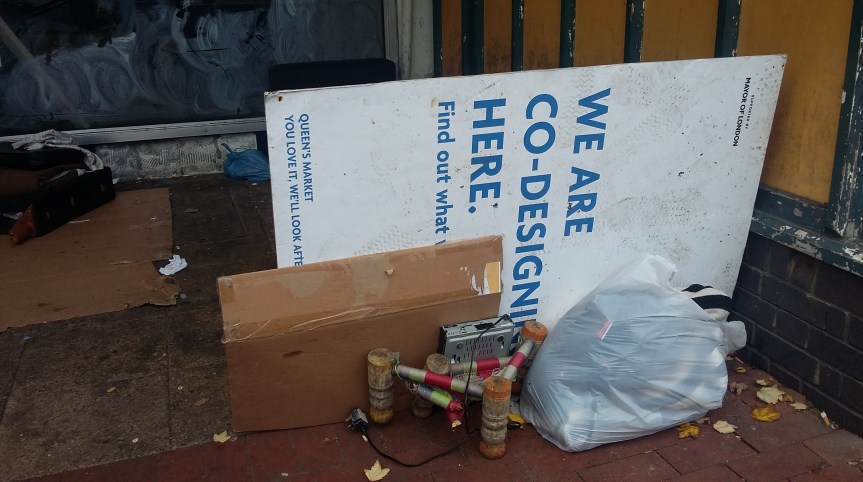
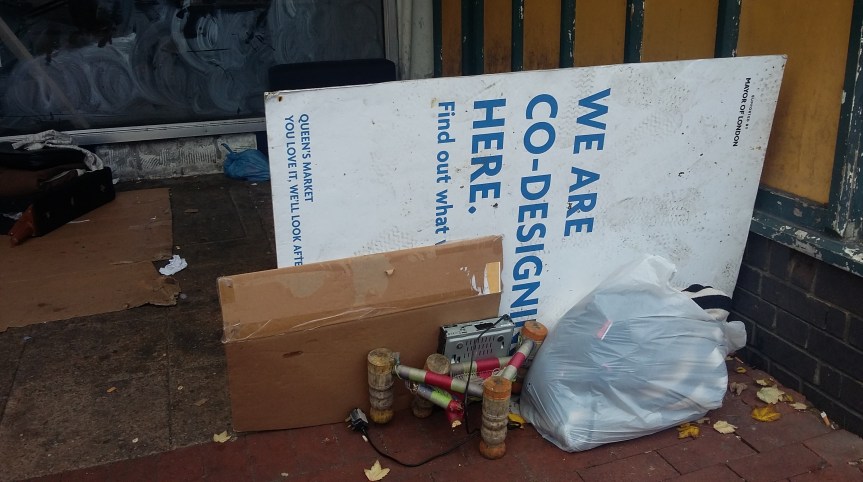
A homeless person uses Newham’s Co-create marketing boards as a makeshift home at Queen’s Square, Upton Park.

Capacity and Viability study wants regeneration at any cost

Despite the ‘cluster of attacks’ from the Council’s planning department while the Good Growth funds are being swallowed up by private consultants, the Council have simultaneously started another group to look at partial or full-scale regeneration and redevelopment of Queen’s Market. FoQM are not happy that all these important things are taking place at once as it confuses people, and where the process has been less than transparent and privatisation of public land is likely to be considered.

The Council’s co-create website is so complicated and unclear that it’s not allowed a number of FoQM locals to get on board. Instead the same old “yes” people fill these spaces to say negative things about the market so to ‘rubber stamp’ regeneration.

We think that Newham Council’s Co-create website not only digitally excludes huge sections of our community for whom Queen’s Market is a lifeline, but the Council and their “friendly” consultants are complicit in not wanting to hear the true views of the diverse market users.

Do you know whether your voice will be heard in the Council’s Capacity and Viability study?

Link to the Capacity & Viability regeneration project: https://www.newham.gov.uk/regeneration-1/regeneration-project-green-street/3

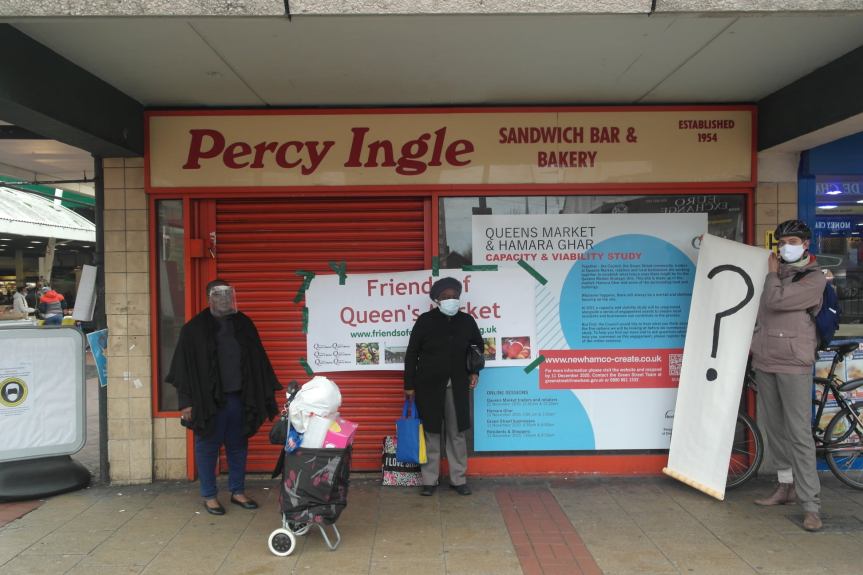
Local people and FoQM campaigners ask questions around transparency and accessbility of the Council’s regeneration plans

Leeds University report gives vital market facts

Over the last few years extensive research has been carried out by researchers and academics from the School of Sociology and Social Policy, University of Leeds and Queen’s Market in Upton Park was one of their case studies.


Taylor M, Watson S, González S, Newing A, Buckner L and Wilkinson R. 2021. Queen’s Market: a successful and specialised market serving diverse communities in Newham and beyond:

Download link:

https://trmcommunityvalue.leeds.ac.uk/wp-content/uploads/sites/36/2021/06/210531-M4P-Queens-FINAL.pdf

Markets matter more during pandemics

LOW PRICES are the bedrock of Queen’s Market and why so many individuals and families need to shop here. SIZE MATTERS. A trader keeps prices low by buying a whole palette wholesale, and passes these savings onto the customer, in the form of cheaper prices. If space were restricted and only small amounts of wholesale goods could be purchased, prices would rise significantly. A palette takes up space, so some traders need a large floor area and enough storage space. Why storage space? A trader sees a wholesale bargain and needs to be able to buy it then and there, but may need to store the goods temporarily before putting them out for sale.

LOW STALL AND SHOP RENTS mean LOW PRICES FOR CUSTOMERS.

It doesn’t take a genius to work out this equation but the Council struggles to do so. Traders have been hit with greedy rent increases that have destabilised them or pushed them out. Much-loved businesses have gone, such as the stationers and furnishing curtain fabric shop. Yet, as shown in the 2011-12 accounts, the market can pay its way and still make a surplus when charging lower, affordable rents.

Customers have told FoQM that Queen’s Market has helped them gain access to fresh affordable food with little need to queue during the hardest times of the recent Coronavirus lockdown.

Empty spaces

From 2009 to 2013 we had a market development manager whose job was not just enforcement –acting like the school headmaster keeping the kids on order – but developing and improving the market. We had our arguments with him but the market was buzzing – full of stalls and with a waiting list. And all this was achieved with a staff of four!

Now from outside the market we have the London Mayor promising much-needed new flooring, lights and toilets, but meanwhile – the market is shrinking!

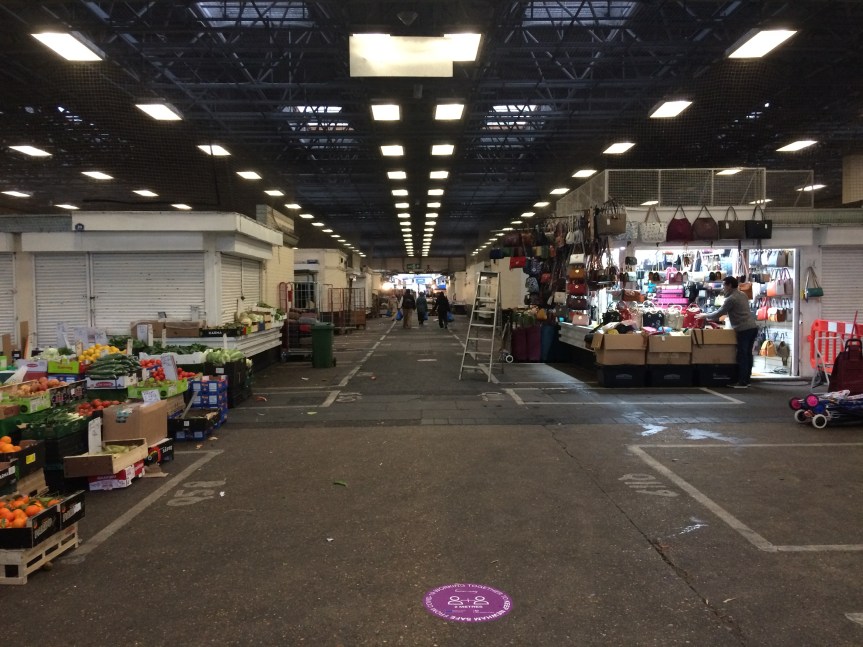
Empty spaces in the market are increasing at an alarming rate. It makes the market look dead and frustrates the shoppers who like to be able to have a good walk round and compare prices on a number of stalls. We have more staff in the market office and fewer traders.

What’s going on? As far back as 2006 developers argued that the market “suffers from a proliferation of certain uses such as …. fruit and vegetables”!  As far as we can see there seems to be a programme to cut down on fruit and veg stalls; ones that close are not replaced: existing traders who want to expand into another pitch get told ‘no’ when they ask. And this goes for other goods like groceries.

So now we have empty spaces in the market – and a waiting list of traders who want to trade in goods that the Council thinks are at ‘saturation’ point. And more traders who did not even make it on to the waiting list – at community gatherings tales are told of would-be traders who have knocked on the office door and abruptly been refused- just like that. Perhaps a process could be worked out to give a bit of  transparency so that everyone can be aware that the office staff uphold the highest standards of customer service at all times.

Disappointed shoppers who want more stalls selling the gear they love to buy, disappointed traders who aren’t allowed to sell the goods they can buy skilfully at great wholesale prices – what’s behind this problem? We’d hazard a guess that the Planning department would like to see the market run down so that there is plenty of space for their beloved luxury flats.  And that their dreams of the wealthy flocking to Newham to buy £500k apartments kind of make them despise the ordinary Newham people who need cheap food. They want the market to sell ’gentrified ‘gear; oil paintings and £5 fancy loaves of bread. Trouble is Newham’s traders don’t want to sell this stuff because nobody will buy it.

Is there any hope? Well the top bods who oversee ’public realm’ are doing a review of markets strategy including goods sold and restrictions. They have promised to tell us what’s going on.

‘People at the heart of all we do’ Which people? Planners, developers, or local shoppers and traders? We just want our ‘buzzing’ market back! And Friends of Queens Market will fight for it.

Leeds University and Markets 4 People study due soon

We are very fortunate to have the Leeds University / Markets for People research study that supports with facts and data all the aspects of the market championed by FoQM. This study comes out of the UK market sector’s interest in evidence for the social and cultural value of street markets.

The study should be required reading for council officers, councillors, contractors and anyone with decision-making powers over Queen’s Market.

https://trmcommunityvalue.leeds.ac.uk/wp-content/uploads/sites/ 36/2020/04/200420-Queens-Market-Presentation-Revised-v13.pdf

We agree 100% with the study’s overarching recommendations, as well as the detail:

  • Our research shows that Queen’s Market continues to deliver significant community value, despite its legacy of fragmented governance, lack of trust and insufficient investment in market infrastructure.
  • The council is taking action to resolve these issues but there needs to be a full recognition that any developments might impact on its existing community value and potentially put it at risk.
  • Queen’s Market is unique in delivering strong community value particularly for groups that otherwise might struggle. This should be seen as a strength and opportunity for Newham Council to build on in light of new policies for community wealth building, inclusive economic development and social value procurement. The Leeds team has also made valuable comments on THE VIABILITY AND CAPACITY STUDY – download and read more here:

See the Markets 4 People, University of Leeds initial finding here (scrolling PDF):

FoQM warn against planning department’s rhetoric

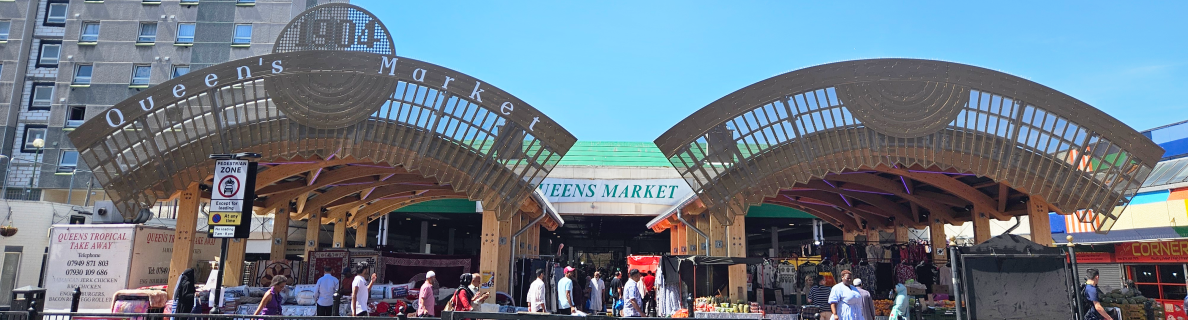
The market has been in existence since 1904 and has a vital role to play for the people of Newham. Since it was formed in 2003, Friends of Queen’s Market (FoQM) has supported, promoted and defended the market. Over the years FoQM realise that words have been SPUN OUT OF CONTROL to fit with development plans and to serve PRIVATE AGENDAS with decisions being made behind closed doors.

The market has been internationally and nationally recognised. Queen’s Market is worth protecting, by any measure, and must remain strong into the future, whatever happens.

The council says: “Whatever happens, there will always be a market and sheltered housing on the site.” But does this statement have any real meaning? A few random stalls in a concrete wasteland can be called a market, like Rathbone Market in Canning Town. There are few facts available about the council’s intentions but one thing is clear: because of Newham’s Local Plan, Queen’s Market is being seen as a development site and is unlikely to survive any new proposals unless the Council understands the nature and role of this market and genuinely wants to keep it running as we know it today.

Poor Rathbone Street Market in Canning Town… once a thriving centre of the community, now resembling an empty car park.

Over the years we’ve had many conversations with Newham’s planning department but they just don’t care. They say one thing that later results in the opposite. The local people suffer because of planners’ ‘lies’. All they want to do is wash their hands off of our public spaces. These public spaces belong to us all and we deserve access to them.

– account from a shopper and member of FoQM