
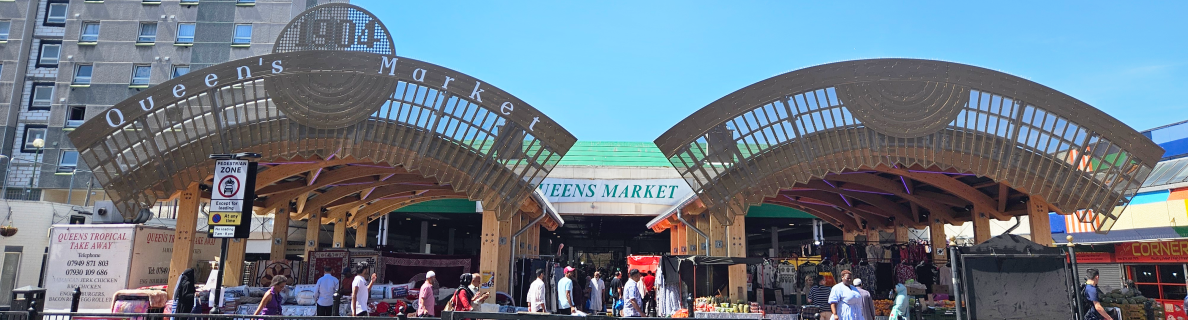
Threats that began in 2003 were seen off, but now
the threats to the Market have returned. They are:
- Long-term plans for development of the Market site. the council is working on a “Capacity and Viability Study” right now. This proposes building a health centre, library, housing, or all three, on the site. [read more below]
- No improvement in the running of the market. THE COUNCIL FREQUENTLY REFUSES TRADERS WISHING TO OPEN NEW STALLS : BAD CLEANING HAS CONTINUED FOR YEARS.
- Unfair rent rises for shops and kiosks and not replacing the ‘dodgy leases’ given to some traders.
- A failure to hear and respect shoppers and traders’ concerns about the market and its future.
The council has TWO OPTIONS’, both for redevelopment AND PUTTING HOUSING ON MARKET LAND.HOUSING WILL BE LUXURY APARTMENTS ;NO SOCIAL HOUSING OR ONLY A TOKEN SPRINKLING.
The council’s ‘long-term opportunities for the site‘ are being steered by the ‘Capacity and Viability Study’ done by consultants at a cost of over £200,000. The results of the study are due to be presented at Newham’s Cabinet at the end of the year. Note: they now call it the ‘Investment Strategy’.
At the height of Coronavirus the council launched a public consultation for this study on the ‘co-create’ website. They gave the public a choice of five “options” for the market’s future. Option A was ‘maintain only’ (i.e the Council does all the maintenance work that you would expect of a good landlord, with no alteration to existing stalls, shops and kiosks.) Options B,C,D and E ranged from redevelopment to total demolition of the market and Hamara Ghar. (see Phases – Previous Options and Engagement https://newhamco-create.co.uk/en/projects/queens-market-strategic-site/1 )
Friends of Queen’s Market conducted a survey of non-internet users and found an overwhelming preference for Option A ‘maintenance only’. But the Council claimed there was “no overall preference for the five options”, even though they had acknowledged our survey. The Council promised that all five options would be examined.
Then suddenly last December the council decided that only two options would be evaluated. They dropped Option A ‘maintenance only’. Now both options involve further building on the site. New Option A involves a health centre, library, neighbourhood centre on ground floor and/or roof. Option B adds youth centre, adult education centre and housing. Both these mean building on the site, which will affect the market and shops.
So the so-called consultation does not allow the choice to reject further building on the site, even though ‘maintain only’ was a popular choice.
It was unfair to consult people at a very difficult time during Covid19; confusing that the ‘Good Growth grant was being consulted on at the same time; people who don’t use phones or internet were excluded. We believe the Capacity and Viability Study will not produce fair or proper results.
AND IT GETS WORSE . . .
IN MAY 2024 THE COUNCIL HELD A PUBLIC ENGAGEMENT OVER THE TWO OPTIONS
BUT THEY CHANGED THEM SO THAT NOW BOTH OPTIONS INCLUDE BUILDING HOUSING ON MARKET LAND. THE PUBLIC WERE ASKED TO CHOOSE BETWEEN THESE OPTIONS. MANY REJECTED BOTH AND SAID SO ON POST-IT SLIPS. TO DATE THE COUNCIL HAVE NOT PUBLISHED THE RESULTS OF THAT ENGAGEMENT STUDY. DETAILS OF THESE FINAL TWO OPTIONS – REBRANDED AS ‘EMERGING DESIGN OPTIONS’ – ARE HIDDEN AWAY AND ACCESSIBLE ONLY BY THIS LINK https://drive.google.com/file/d/1NV8IpzqpKuL6PWe0LWgAbAKcvmvr2QvY/view
What local people said…
Transcribed from the post-its feedback 24th May 2024 at the market):
“Clean market. No housing – no more people wanted. Other facilities just outside. Market is ok. Lift to car park wanted. Want market to stay open.”
“It’s the cheapest market us for hardly offered. Don’t lose it. Please.”
“Keep market in location. Too crowded to have on Green Street. Concern housing won’t be affordable. Health centre, affordable housing a good idea.”
“No we don’t like this plan.”
“Like market as it is.”
“Support the market as it is – don’t support the development.”
“No don’t like this plan 2a & 2b.”
“Keep our heartland. No demolition.”
“This is bullshit. No. Because it is No.1 market.”
“Keep market. Improve lighting, floor, lift, etc.”
“Like health centre & community centre on site. Don’t want housing, feel it’s not for local people. Concerned about increased cost of food etc.”
“Please leave market.”
“No need the flats. Keep the market.”
“Modernise it. But same food at same prices.”
“Leave it like it is. We go shopping every day. Lots of people come from far away. Leave it like this please please please please.”
“Because parking prices going up we come here a lot less often than we use to.”
“No space for temporary market space here.”
[Illegible]
“Need more public toilets. Kids, elderly people.”
“Better lighting.”
“Prefer 2a. because too much traffic & litter on Green Street – dangerous for children.”
“Will new market mean higher prices for traders and therefore higher costs for people? Design less important than that.”
‘Second option had more parking – why we said yes to 2b. Cost of parking puts people off. Affects small traders.”
“Should have translators here as lots of people don’t speak English as first language.”
“Don’t trust Council to listen and respond to people – residents don’t feel informed [3 words illegible]”
“5 more slips written too faintly to transcribe]”
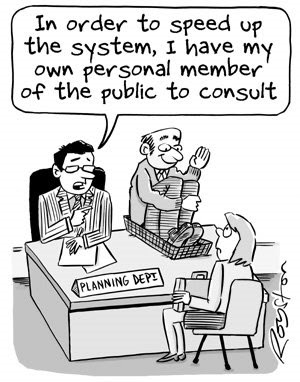
Image above: Cartoon by Royston Cartoons (source: roystoncartoons.com)
Other dodgy bits of the Capacity and Viability Study:
- The £5.3 million Good Growth grant for the market could be a gross waste of public money because if the market is redeveloped, the promised new floor and lighting could be be dug up and removed.
- We believe housing development does not sit well with street markets. Take the sorry-looking Rathbone Market in Canning Town as an example. Public uses would be more compatible.
- We think the usual narrow economic models will be used to ignore the value of the current market. Queen’s Market’s worth needs to be counted using progressive economics which focus on Community wealth building principles and the social and health value the market brings.
“Co-production” ? Why the narrow choice of consultees for the working group?
The only people who have sat around a table in ‘working groups’ are a small number of so-called ‘key stakeholders’. To be on the key stakeholder working group you have to be:
– a Queens Market trader or
– a ‘local resident’ living within 100 meters of the market or
– a ‘local resident’ living between 100 and 400 metres of the market.
We argued strongly that market shoppers should also be included but were told that ‘the process cannot be changed’. Who decided this process? People who qualified as local residents put themselves forward, were interviewed by telephone and then were chosen or rejected with no reason given. We have no guarantee that the ‘local residents’ represent the majority of market users, or even local residents. One of them appears to have been selected as late as April this year!
Newham Markets Policy and Strategy Review
THE COUNCIL PAID CONSULTANTS FROM THE RETAIL GROUP TO STUDY ITS MARKETS. THEIR REPORT FOUND SAID QUEENS MARKET IS ‘VERY POPULAR WITH DIVERSE RANGE OF SHOPPERS’ WITH ‘A VERY GOOD FRUIT & VEG OFFER’.
WAS THE COUNCIL UPSET BY THIS PRAISE FOR THE MARKET? THEY HAVE CERTAINLY KEPT QUIET ABOUT THE REPORT SINCE IT CAME OUT LATE 2022 – you can read the PDF below:
Summary of Research Findings
by the Retail Group
Newham Markets Strategy and Policy Review More choice is especially wanted in fruit & veg,(page 13)
Page 17 says One of biggest markets in East London plus is anchor for Upton Park. The market is evidently very popular with diverse range of shoppers. There is a very good fruit & veg offer, along with women’s clothing / accessories, haberdashery & jewellery. (Published November 2022)
‘Capacity and Viability Study’ gives two ‘OPTIONS’, both for redevelopment.
The council’s ‘long-term opportunities for the site‘ are being steered by the ‘Capacity and Viability Study’ done by consultants at a cost of over £200,000. The results of the study are due to be presented at Newham’s Cabinet at the end of the year. Note: they now call it the ‘Investment Strategy’.
At the height of Coronavirus the council launched a public consultation for this study on the ‘co-create’ website. They gave the public a choice of five “options” for the market’s future. Option A was ‘maintain only’ (i.e the Council does all the maintenance work that you would expect of a good landlord, with no alteration to existing stalls, shops and kiosks.) Options B,C,D and E ranged from redevelopment to total demolition of the market and Hamara Ghar. (see Phases – Previous Options and Engagement https://newhamco-create.co.uk/en/projects/queens-market-strategic-site/1 )
Friends of Queen’s Market conducted a survey of non-internet users and found an overwhelming preference for Option A ‘maintenance only’. But the Council claimed there was “no overall preference for the five options”, even though they had acknowledged our survey. The Council promised that all five options would be examined.
Then suddenly last December the council decided that only two options would be evaluated. They dropped Option A ‘maintenance only’. Now both options involve further building on the site. New Option A involves a health centre, library, neighbourhood centre on ground floor and/or roof. Option B adds youth centre, adult education centre and housing. Both these mean building on the site, which will affect the market and shops.
So the so-called consultation does not allow the choice to reject further building on the site, even though ‘maintain only’ was a popular choice.
It was unfair to consult people at a very difficult time during Covid19; confusing that the ‘Good Growth grant was being consulted on at the same time; people who don’t use phones or internet were excluded. We believe the Capacity and Viability Study will not produce fair or proper results.
Other dodgy bits of the Capacity and Viability Study:
- The £5.3 million Good Growth grant for the market could be a gross waste of public money because if the market is redeveloped, the promised new floor and lighting could be be dug up and removed.
- We believe housing development does not sit well with street markets. Take the sorry-looking Rathbone Market in Canning Town as an example. Public uses would be more compatible.
- We think the usual narrow economic models will be used to ignore the value of the current market. Queen’s Market’s worth needs to be counted using progressive economics which focus on Community wealth building principles and the social and health value the market brings.
“Co-production” ? Why the narrow choice of consultees for the working group?
The only people who have sat around a table in ‘working groups’ are a small number of so-called ‘key stakeholders’. To be on the key stakeholder working group you have to be:
– a Queens Market trader or
– a ‘local resident’ living within 100 meters of the market or
– a ‘local resident’ living between 100 and 400 metres of the market.
We argued strongly that market shoppers should also be included but were told that ‘the process cannot be changed’. Who decided this process? People who qualified as local residents put themselves forward, were interviewed by telephone and then were chosen or rejected with no reason given. We have no guarantee that the ‘local residents’ represent the majority of market users, or even local residents. One of them appears to have been selected as late as April this year!
Newham Markets Policy and Strategy Review
FoQM met with the consultants doing this Review, who are called The Retail Group. We have heard nothing from them since and we are concerned that the study is really about supporting the redevelopment of the market. https://newhamco-create.co.uk/en/projects/newham-markets-review
Planning Threats: the planning system has haunted Queen’s Market since 2004.
It began with developer St.Modwen’s proposed tower block and continued with Newham’s ‘Local Plan’ which names the market at ‘strategic site’ for development. Friends of Queen’s Market has had to keep a sharp eye on planning matters. See Planning Threats in detail here
 To promote and preserve a thriving publicly-owned historic street market