
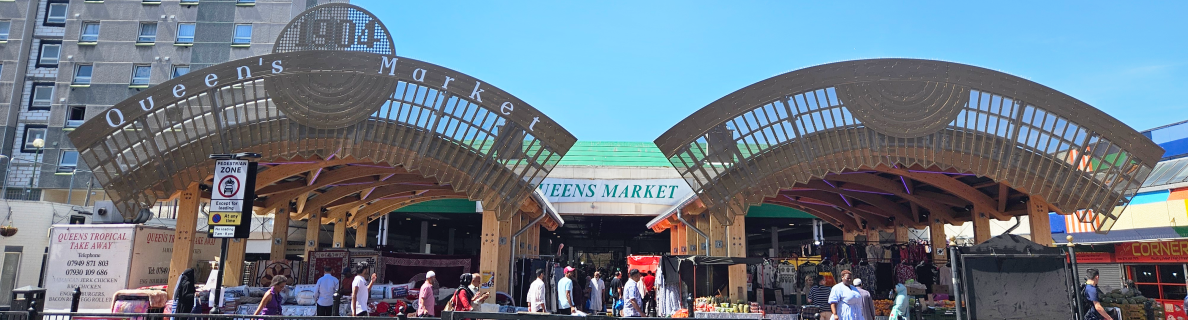
Working-class ethnic minority communities across the city appear to be united by similar concerns: once welcomed to help rebuild the UK after the Blitz (WWII), many now feel they are treated with disregard by politicians and decision-makers. This month, however, People Power has broken through the political ranks in Newham, signalling that the ethnic minority votes can no longer be taken for granted by career politicians.
Just Space Network’s Alternative Plan for a caring city
First of two newly published reports represents years of interviews by researchers and campaigners from Just Space Network (JSN), an informal alliance of community groups, campaigns and organisations advocating for fairer planning and development across the city. Acting as a collective voice for grassroots Londoners and local communities, JSN regularly brings together groups such as Friends of Queen’s Market (FoQM) with other struggles.
JSN’s latest report is the result of three years of research and engagement, gathering evidence on what Londoners want from their city plan. It has been shaped by the need for an alternative to successive London Plans which, over the past 25 years, have worsened conditions for many residents by deepening the housing and rent crisis, privatisation of public land, damaged street markets while enabling unchecked property development to reshape and hollow out communities – all for a quick buck for themselves!
The report argues that the close relationship between developers, political interests and finance has contributed to a model of city-building that often overlooks the needs of existing Londoners. JSN’s proposed Alternative London Plan for a caring city, offers a different vision for London’s future and can be read online via the link below [FoQM feature on page 41]: https://justspace.org.uk/wp-content/uploads/Justspace_Alt_Plan-2026.pdf
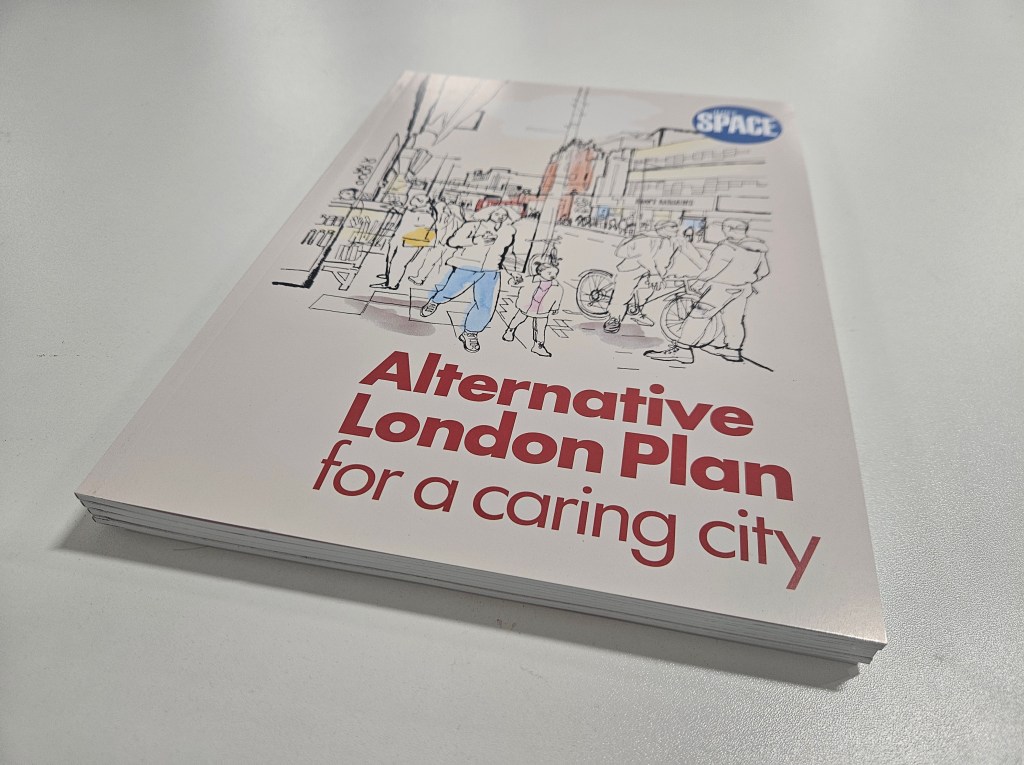
Image (above): Printed copies of the report are available to collect from selected community spaces.
How do we effectively address the Racism in the UK planning system?
This second published report follows the emergence of Protect Our Places (POP) in late 2023, a coalition of eleven campaigns, organisations and community groups across London, including FoQM. POP brings together anti-gentrification campaigns from across the capital, all working to protect the markets, town centres, high streets and affordable retail spaces that are central to their communities and cultural identity. You can read the Protect Our Places (POP) anti-gentrification report here: https://latinelephant.org/coming-together-pop-report-released/
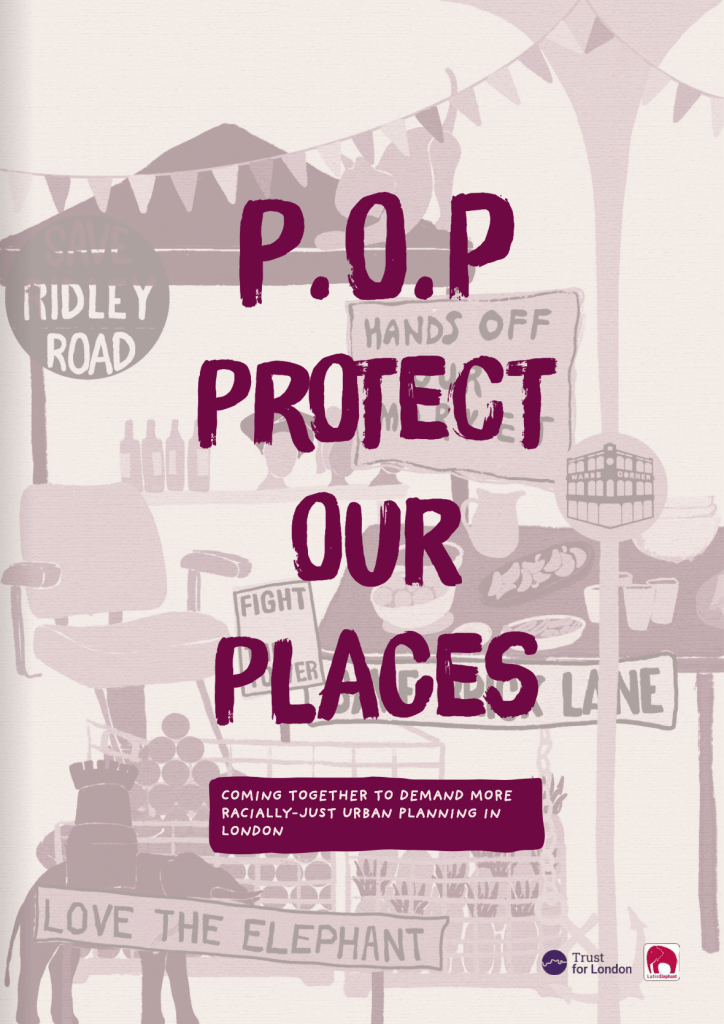
Image (above): front cover of the report. Printed copies are available to collect from community spaces.
Is Newham witnessing a three-way political split, or are signs of a more democratic future beginning to emerge?
Recently, our supporters posed questions at the local election hustings at the Tate Institute in Silvertown, Newham – historically a social club for Tate & Lyle factory workers. The venue remains an important community space that now needs support to continue serving local residents. Those involved are working hard to keep the space open for vital community use, and donations are encouraged to help with renovation – click here to find out more. The community organisers generously hosted a hustings with all prospective Mayoral candidates on Saturday 2nd May, yet Labour’s Mayoral candidate was notably absent – rumours abounded, suggested concerns about a potential “Green trap” may have discouraged attendance. The Newham Independents candidate Mehmood Mirza spoke about his mistreatment having been targeted, with his family being followed in the lead up to him taking public office – see these YouTube videos ‘Targeted by Labour for their ethnicity’ – see: https://www.youtube.com/watch?v=Q5vHEkYo6LU
Also see: ‘The Labour Files: Episode 3. The Hierarchy – Al Jazeera Investigations’ [M. Mirza mentions being followed at point 39:49]: https://www.youtube.com/watch?v=P-cHBQf5z_M
The Green Party candidate, Areeq Chowdhury, a self-described “data nerd” did really well to face the audience largely alone because Mirza had to leave early – if Areeq has further information on how Newham Council uses public and retail data trends, whether larger private companies have access to this data, or why key local data, including statistics on the importance of Queen’s Market, food poverty and community needs continues to be overlooked in favour of speculative development plans, we encourage him to share it with us.
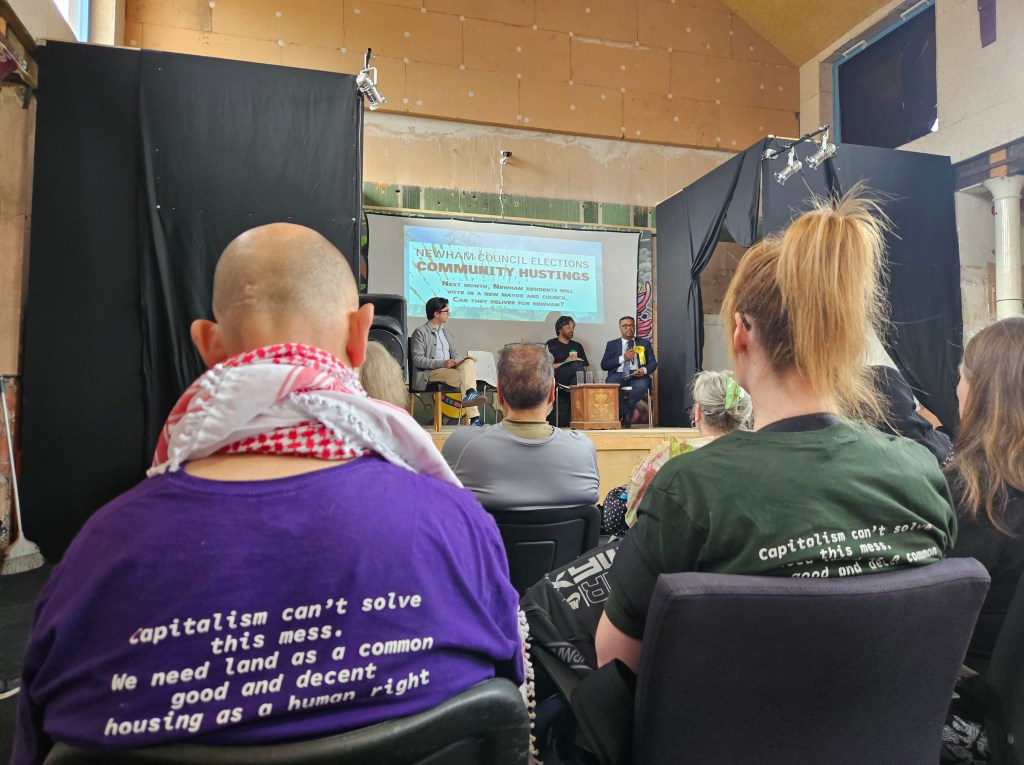
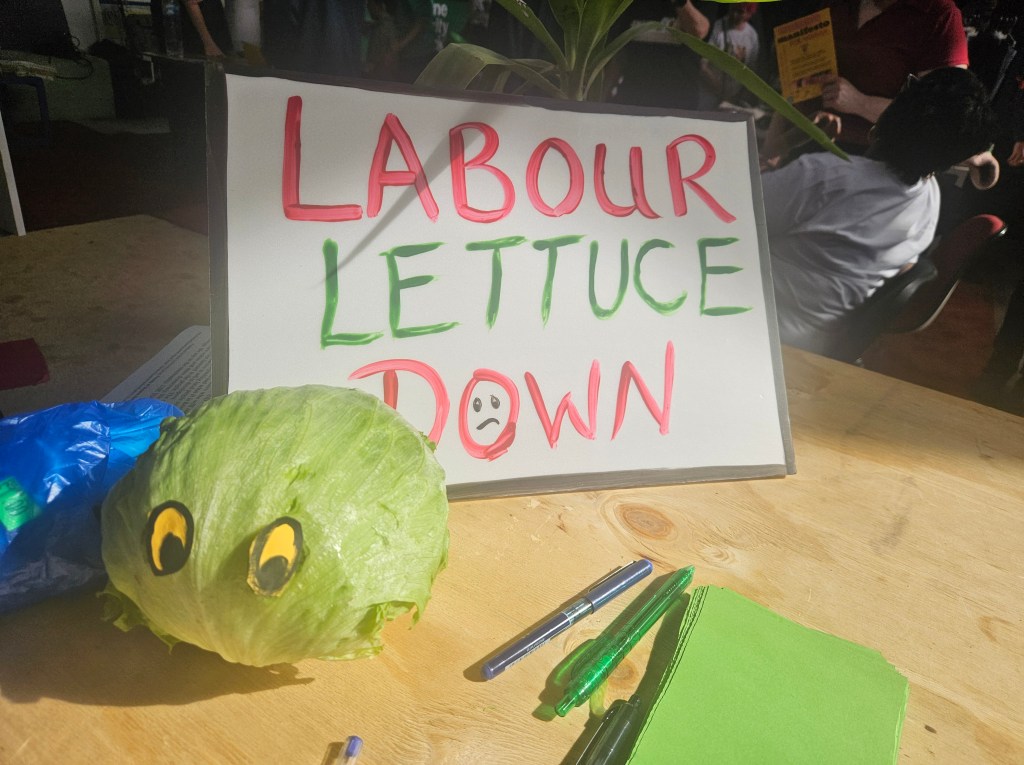
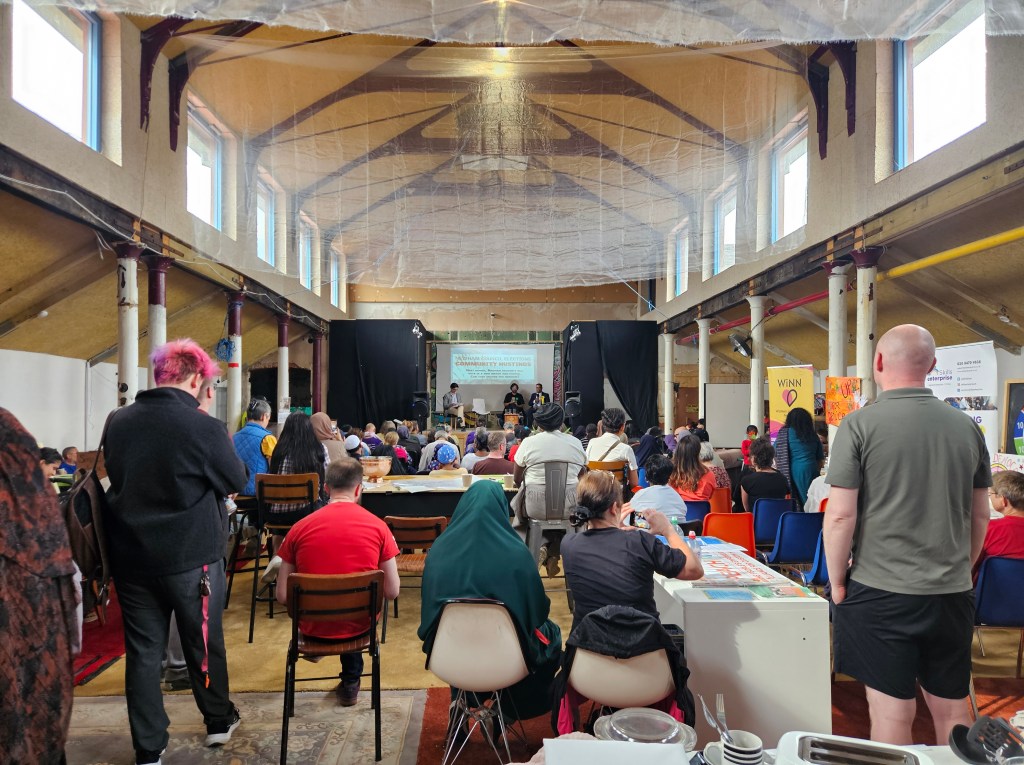
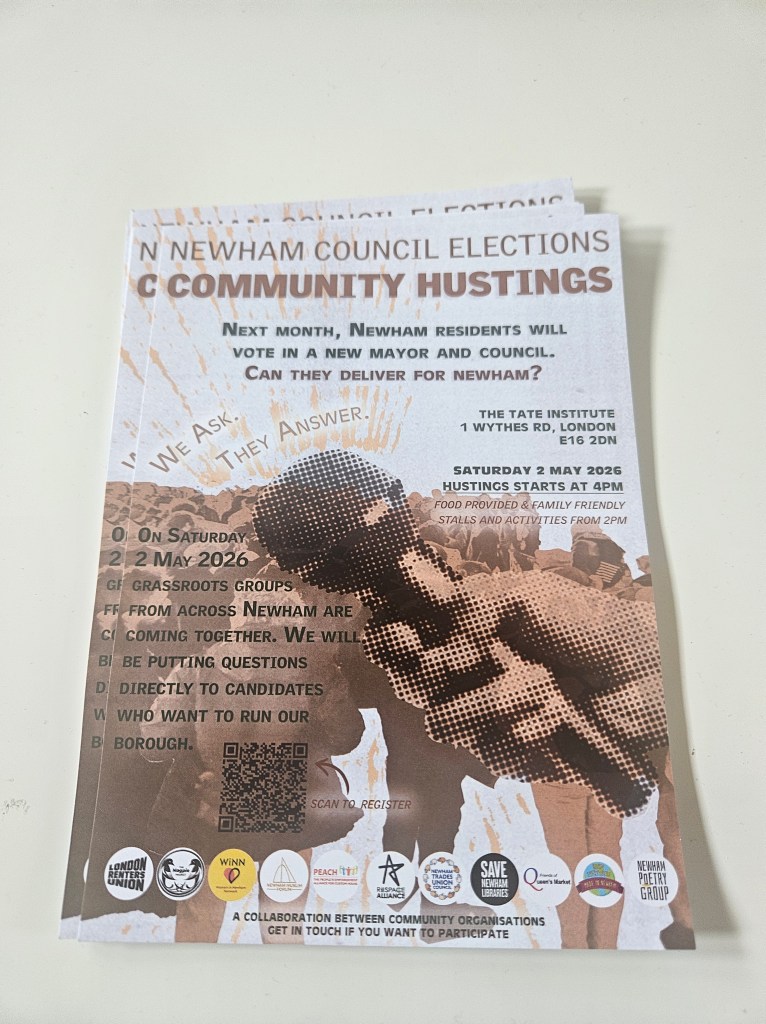
Scrolling gallery of photographs (above): A sign was placed where the Labour candidate was supposed to be, reading simply: “Labour?”
The proof is in the ballot box
Following the elections, the Newham Independents Party achieved a significant increase in council seats in and around Queen’s Market, particularly in Plaistow North (where Queen’s Market is located), Boleyn and Green Street wards – securing a whopping 24 council seats in total. However, the green shoots have been most surprising, with Green Party support resulting in 16 Councillor seats secured across other parts of the borough. Now, with no overall control, Newham Council’s long-standing one-party dominance appears to survive largely through Labour’s directly-elected mayoral system – clinging on for dear life as career politicians defend an ageing, crumbling structure that has rarely worked in the interests of Newham’s diverse and growing population.
For many local residents, the latest election results reflect the continuing importance of Queen’s Market in the lives of Londoners; at a time when food prices continue to rise and more families are being pushed deeper into poverty, people have shown what matters most by voting differently.
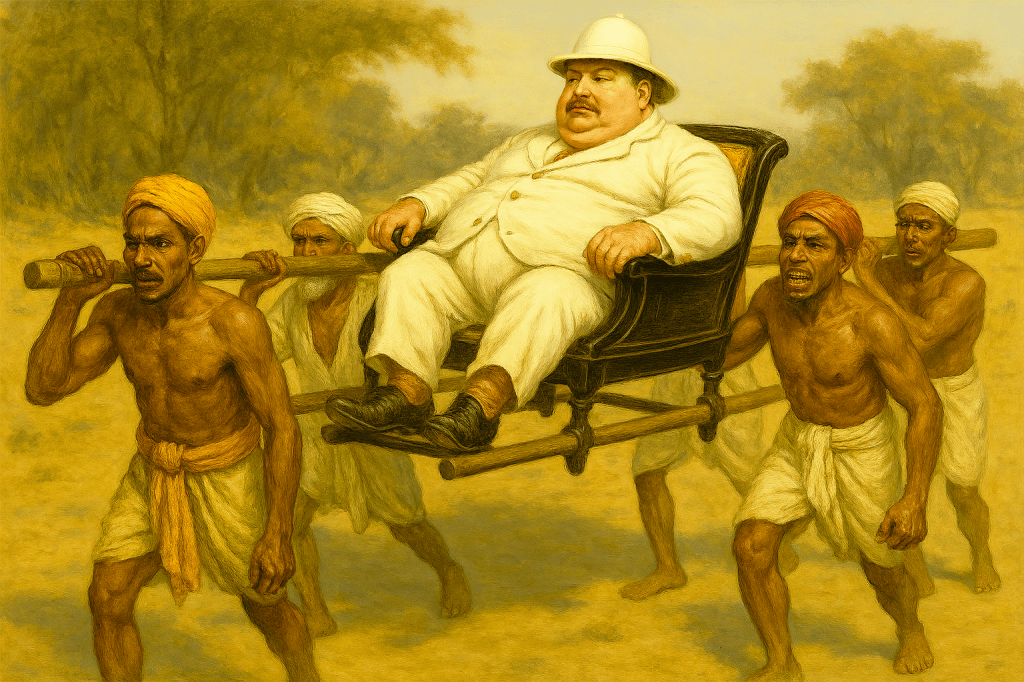
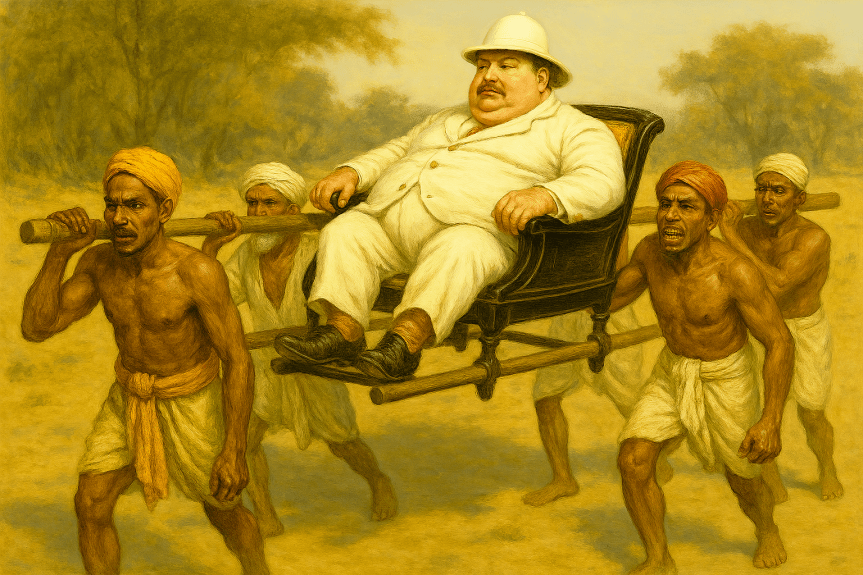
Image (above): “One finds oneself in need of an additional manservant, in order to arrive at the club with suitable haste” thought the colonial master. Are colonial roles like master and manservant being played out in Newham’s political scene?

